

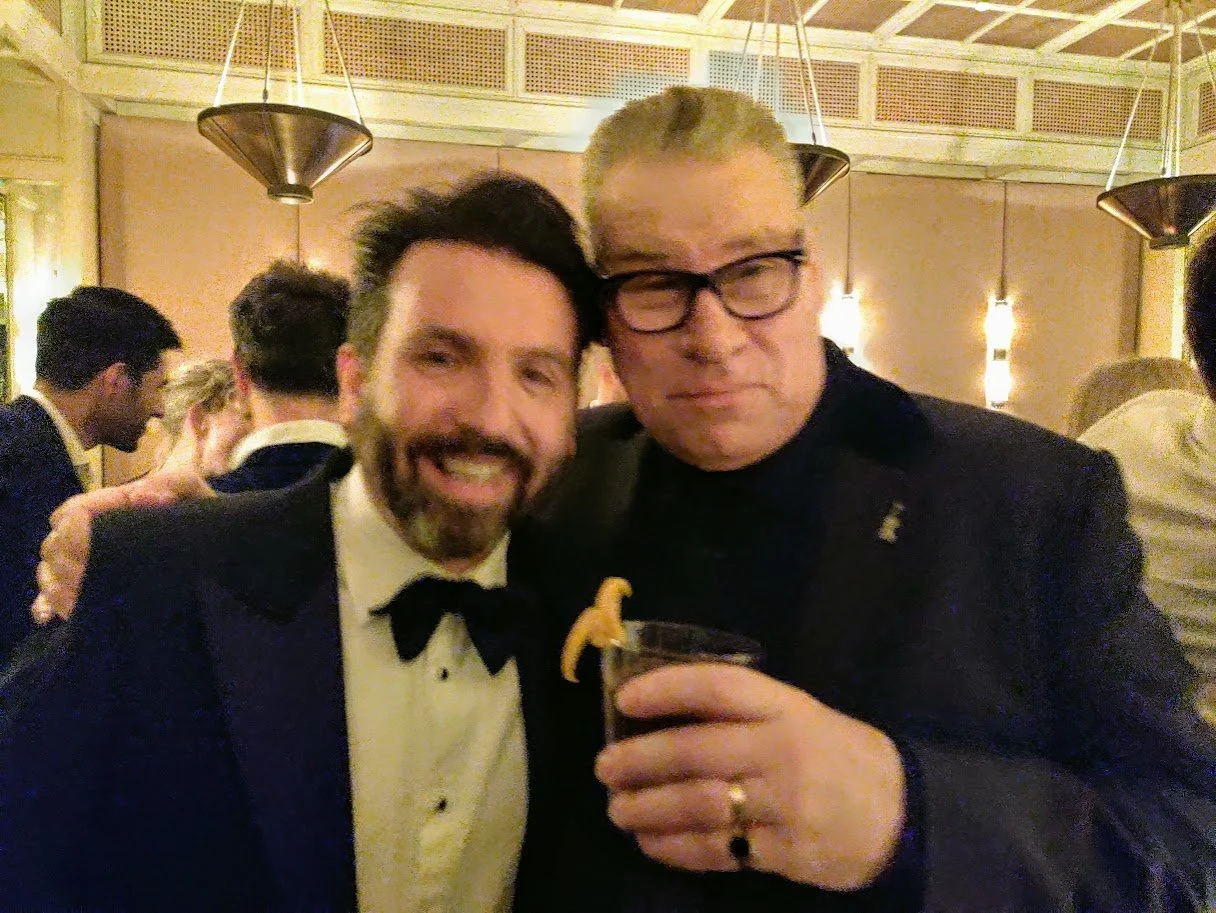
Romane and I were guests of Jeff Reichert (producer of the Netflix film AMERICAN FACTORY, which was nominated for both the BAFTA and Academy Award for Best Documentary). We had a swell time, especially Romane who strode up to the likes of Adam Driver and Rian Johnson and talked their ears off. I was polite to Jenna Coleman but not chatty, which left her perplexed (Romane bailed me out on that one too). Mark Kermode wasn’t allowed in straight away but we had a chance to catch up when he was!

“Kiarostami is not an angry filmmaker; he is not even a very emotional one (he once told a French journalist he had never once cried in the cinema). He is, like Takashi, serene. He would not conceive of using his work as a form of activism. The irony of his ostracization by the authorities in his home country of Iran—an irony so profound that it would be amusing if the circumstances were not so deplorable—is that neither he nor his films ever attacked the Iranian government, its ideology, nor the enforced lifestyle of its inhabitants. In an echo of (fellow painter) Eisenstein’s artistic dilemma, Kiarostami’s austere, limpid life stories were banned because they were so artfully and subtly presented, and by trusting the audience’s imagination they left so much unexplained, that the authorities did not understand them. So, they reasoned, they must be subversive.”
I was thrilled to contribute this essay on one of the most luminous films of the 2010s. Number 18 on Reverse Shot’s ‘Best of the Decade’ poll: LIKE SOMEONE IN LOVE.
“Booth (Brad Pitt), the calmest powder keg you'll ever see, is the film's heart of darkness. He bears witness from his vantage point on Rick’s roof, then at Spahn Ranch he participates, becoming Hans Landa (as Samuel L. Jackson did in Django Unchained). And the dream will start to turn sour. More than a love letter, it's a eulogy: Tarantino joins Minnelli, Wilder, and Kazan in enriching the ambiguity of the Hollywood myth. If you think the old Cinema, the type we could all soon be lamenting, still has a purpose and value—to excite, provoke, transport, disturb, and enthrall—then don’t despair: it’s all here.”
A momentous year for the movies and sneaking in at number 10, a masterpiece from Quentin Tarantino. You can read my capsule on the film here.

“The outwardly glamorous trappings hinted at in the film’s publicity materials are occasionally apparent—a pivotal sequence at the Ritz-Carlton; Carol’s fur coat and lipstick; martinis for lunch—but they are etched against the soiled, grainy texture of Lachman’s urban landscape. These images and the disarming skill of the lead performances are all of a piece with Haynes’s meticulousness. Despite Haynes’s embracing the sobriety of Nagy’s script, his predilection for iconography (see I’m Not There and Velvet Goldmine) hasn’t fully deserted him: Blanchett looks like pre-Cassavetes Gena Rowlands, while Mara bears an almost insolent resemblance to Audrey Hepburn in Sabrina. Haynes is unafraid to wear his own artistic inspirations on his sleeve and he encourages his collaborators to buy into them: he ingested and recommended to the cast Roland Barthes’s compendium Fragments of a Lover’s Discourse before shooting, and even produced a bespoke playlist of period music (Ella Fitzgerald, Johnnie Ray, Benny Goodman) for his actors to listen to while developing their characters.”
Click here to read my piece on Todd Haynes’ CAROL for Metrograph cinema on the occasion of its 2019 Christmas run.

I was delighted to sponsor Kennington Bioscope’s screening of E A Dupont’s 1928 silent masteriece, MOULIN ROUGE at The Cinema Museum in Kennington on Wednesday 11 December.


“Anton Walbrook is captivating in his unbridled performance style and his total espousal of an old-school, self-destructive and tragic protagonist. But there is something more, too. Walbrook was one of those great film actors who made full and courageous use in his work of his essential otherness (he was an Austrian Jewish homosexual working in a foreign country and language). Although a classically trained actor, in nearly all his memorable English-language performances—but most notably Gaslight (1940)—he drew explicitly on his alien heritage (most obviously represented by his Germanic baritone voice and clipped diction) while in The Queen of Spades he appears to invite the audience to side against him for subconscious reasons other than what he says and what he does.”
Anton Walbrook and Edith Evans are magnificent in this lavish, hallucinatory film. You can read my treatment of it as part of Reverse Shot’s annual Halloween round-up, the Great Pumpkins - here

I was thrilled to guest curate a weekend of films at the Museum of the Moving Image in Queens, NY, celebrating the popular cinema of French-Armenian director Henri Verneuil. Stunts by Jean-Paul Belmondo, dialogues by Michel Audiard, music by Ennio Morricone and Georges Delerue. Fun in the sun!
Many thanks to the excellent Eric Hynes, Curator of Film at MOMI, for this amazing opportunity.

“An apparent ingénue and flibbertigibbet, she is flighty, reckless, preyed upon, and vulnerable, but so utterly mesmeric—and, it must be said, manipulative—as to drive all the principal men in the film literally mad. Quentin commits suicide; Paulot and Scrutzler have a long fight in the rain; Paulot’s own descent into madness takes the form of an attempted lurch into machismo, followed by a corrective retreat into childhood pain and fear.”
I wrote about Juliette Binoche’s gobsmacking debut in Andre Techine’s (and Olivier Assayas’s) RENDEZ-VOUS over at Reverse Shot
I enjoyed my transatlantic interview with Violet Lucca for the Film Comment Christmas podcast of 2016 - discussing the origins of ghost stories at Christmas and especially M R James.
You can listen to the podcast here

M R James ( 1862-1936)
I was delighted to take part last April in the Curzon Cinemas podcast on the subject of Robin Campillo’s masterful BPM: Beats per minute. You can listen to the podcast here.